
Five Obstacles to Green Mobility
CoMotion NEWS - Jack Craver
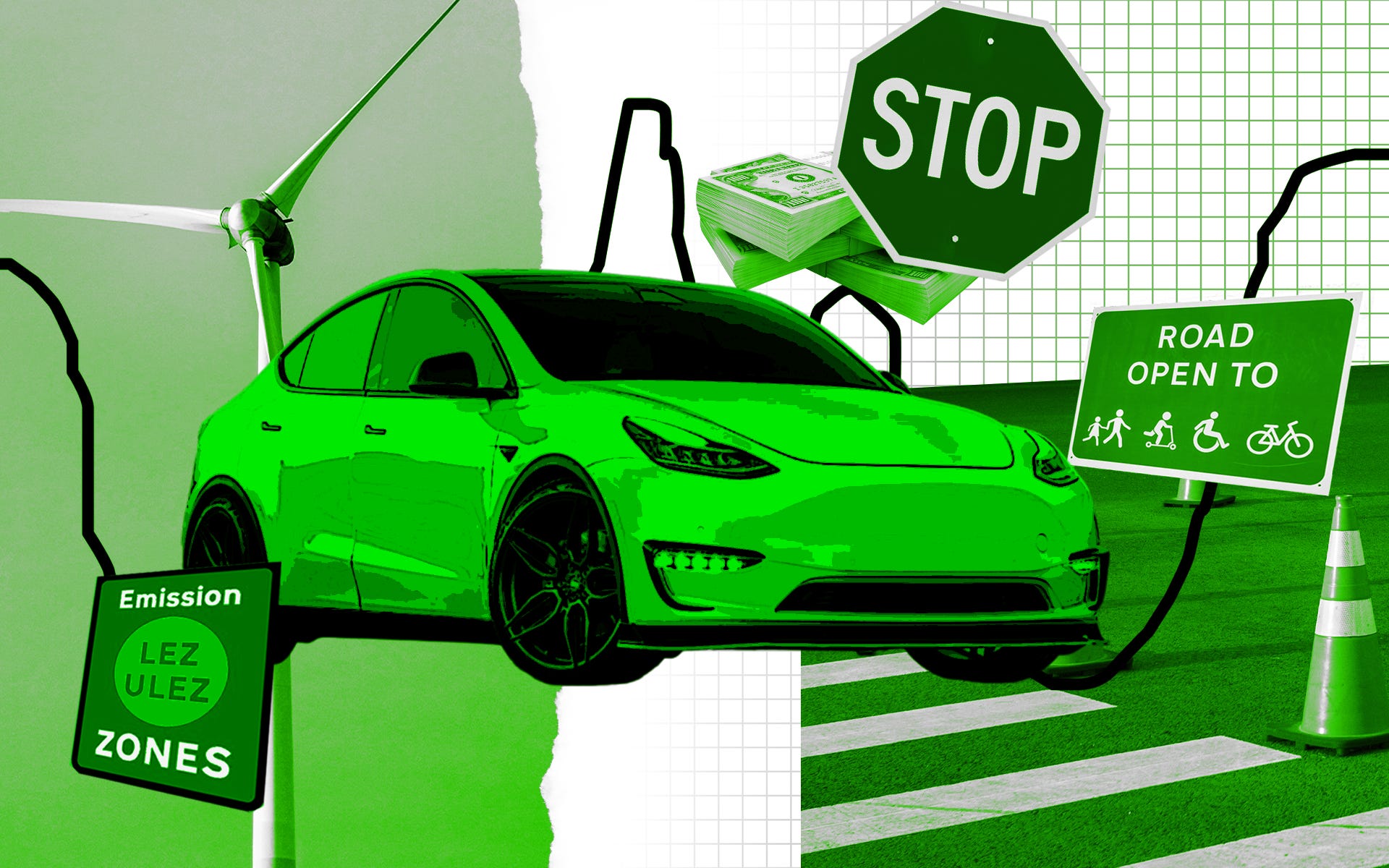
This week, we’re doing a special edition of CoMotion NEWS focused on the major obstacles to a future of green mobility.
There are plenty of reasons to be optimistic about the progress of transportation in coming years thanks to recent waves of technological innovation. Electric vehicles are increasingly common, a huge share of our electricity is now powered by renewable sources and there is good reason to believe we are on the cusp of more paradigm-shifting innovations, from green hydrogen to solid-state batteries.
And yet, those of us rooting for change must acknowledge that there have been some setbacks and disappointments. More importantly, we must recognize the prospect of additional roadblocks that have yet to emerge.
Consumer confidence
The past year has not extinguished optimism about electric vehicles, but it has certainly tempered it. While EV sales continue to grow, the rate of growth has slowed.
It’s become clear that most consumers in the U.S. are waiting for something to fundamentally change about the EV experience before making the switch. First, the price point is still too high for most of the car-buying market. American and European OEMs have not yet figured out how to deliver “economy” priced EVs.
Second, “range anxiety” remains a major barrier to adoption. Part of the problem is a lack of charging infrastructure, which can be addressed in the coming years through increased private and public investment. However, even in areas where EV chargers are already common, but many consumers remain reluctant to switch to EVs because fully charging a battery still takes much more time than filling up a gas tank. Plus, too many chargers don’t consistently work well. Until battery or charging technology evolves to deliver a fueling experience comparable to a combustion engine, a big portion of the motorist market will likely stick with ICEs.
Corporate caution
Over the past three years, automakers and fleet operators have made ambitious commitments to transition to zero-emission transportation over the next decade. Now a number of major players are dialing back their pledges and cutting back on EV investments.
Ford is cutting or delaying $12 billion in previously planned EV spending. Rental chain Hertz is unloading thousands of EVs. Toyota, one of the only major automakers that resisted making a big EV pledge, is increasingly being lauded for its prescience.
The corporate retreat is partially explained by lower-than-expected consumer demand. But it also reflects a concern among corporate leaders that their companies lack the technological chops to deliver EVs at scale. Simply put, the massive investment necessary for a major automaker to transition to EVs makes sense if a global transition to EVs is a foregone conclusion. But if it’s not, then the investment is harder to defend to shareholders. As a result, many automakers are shifting their focus to hybrids.
A tough landscape for mobility startups
The pandemic was extremely kind to future mobility startups. Seemingly every week of 2021 brought news of an EV or AV startup going public at an eye-popping valuation, usually via SPAC.
The hangover following the hype has been brutal. Nikola, Proterra, Arrival, Lordstown and Electric Last Mile Solutions are just some of the startups that debuted at insane valuations but are now bankrupt or on life support. Some of the firms burned through cash and weren’t able to deliver promised products, while others, such as scooter-sharing firm Bird, have delivered but failed to chart a path to profitability.
Naturally, these high-profile failures make it more challenging for other mobility startups to seek funding. The other problem for mobility startups is a general decline in VC funding linked to high-interest rates. The trend will hopefully reverse as the Fed begins to cut rates.
The green backlash
While the public across the western world broadly endorses the idea that climate change is a serious problem that demands action, there is also an increasingly vocal contingent that describes climate science as a hoax and sees climate policies as a threat to their way of life. Some politicians, particularly on the populist right, feed this distrust. A decade ago, the anti-green conspiracy theory du jour was directed at Agenda 21, a non-binding United Nations resolution calling for sustainable communities. These days, it’s “15 minute cities,” the planning concept about building walkable neighborhoods that has been recast by conspiracy theorists as the first step towards “climate lockdowns.”
The most powerful voice for anti-green paranoia is Donald Trump, who frames virtually every green policy as a threat to the American way of life. Wind energy, he says, murders birds, drives whales “crazy,” and causes cancer (in people). He denounces electric vehicles as loser products that will kill jobs.
If Trump returns to office next year, he will be in a position to undermine many parts of President Joe Biden’s landmark climate legislation, the Inflation Reduction Act, as well as some of the greener aspects of the infrastructure law. Even if he lacks the votes in Congress to repeal the law, Trump’s administration could hobble its implementation through the federal rules-making process. For instance, it could set the eligibility for EV tax credits in such a way that no vehicles qualify for them.
Similarly, in the United Kingdom, Conservative Party Prime Minister Rishi Sunak, in a wink to the “15 minute city” conspiracy theory, has declared that he is “slamming the brakes on the ‘war on motorists.’” He halted a major rail project, withdrew a previous commitment to phase out gas-burning cars by 2030 and vowed to prevent local governments from reducing speed limits or closing streets to cars. Sunak’s opponents dismiss the moves as desperate election year stunts from a ruling party that polls suggest is poised for defeat, but Sunak and his party are obviously making the decision based on the belief that there is an appetite for anti-green rhetoric.
The autonomous backlash
While autonomous technology has advanced spectacularly in the last couple years, AV cheerleaders have also been forced to recognize that a truly driverless future is not imminent.
The most notable setback came when Cruise, the GM-backed robotaxi firm, lost its permit to operate driverless vehicles in California following a number of mishaps, most notably one in which an injured pedestrian was dragged 20 feet in San Francisco.
Polls conducted early last year, before Waymo and Cruise began full-fledged robotaxi operations in San Francisco, showed that relatively few Americans had confidence in driverless cars. The Cruise fiasco will only bolster resistance from elected officials and regulators.
AV leaders increasingly acknowledge that simply being as safe as human drivers likely isn’t good enough to gain the public’s trust. For the American people –– and the elected officials and regulators who serve them –– to be sold on autonomous vehicles, they will have to be convinced that AVs are much, much safer than humans.

The Magic City awaits!
Join us on May 6-7 for CoMotion MIAMI, The Next Wave: Integrating Innovation as we bring together key stakeholders driving the Mobility Revolution - global mayors and municipal leaders, public transport operators, technology founders and disruptors, VC investors and established players.
Check out the 2024 program themes, what to look forward to, who’s attending and more from our latest send out CoMotion MIAMI ‘24, May 6-7: A First Glimpse!
Save 50% off on your pass. Hurry, prices jump up on March 2!
Interested in partnering? Our global mobility gatherings in LA, MIAMI, and Monaco offer unique opportunities to grow your brand and connect with ground-breaking companies. Get in touch.
Career opportunities
CoMotion is on the lookout for a talented Program Manager to join the team and lead the programming of our global events, digital media, and advisory platform.
If you have a keen interest in accelerating new and sustainable mobility with the most innovative companies, public sector leaders, and investors, this may be for you. Learn more.
Know someone who could be the right fit? Please share the link!
CoMotion's mobility goodness brought to you by:
Jack Craver,
Editor, CoMotion NEWS
jcraver@comotionglobal.com
Write to us if you would like to suggest content for our next newsletter!
YouTube | LinkedIn | Podcast | Twitter | Facebook